University for the Rest of Us
Under the Influence: How Familiarity Bias and Local State Colleges and Universities Influence Our University Choices
Many of Us Stay Put
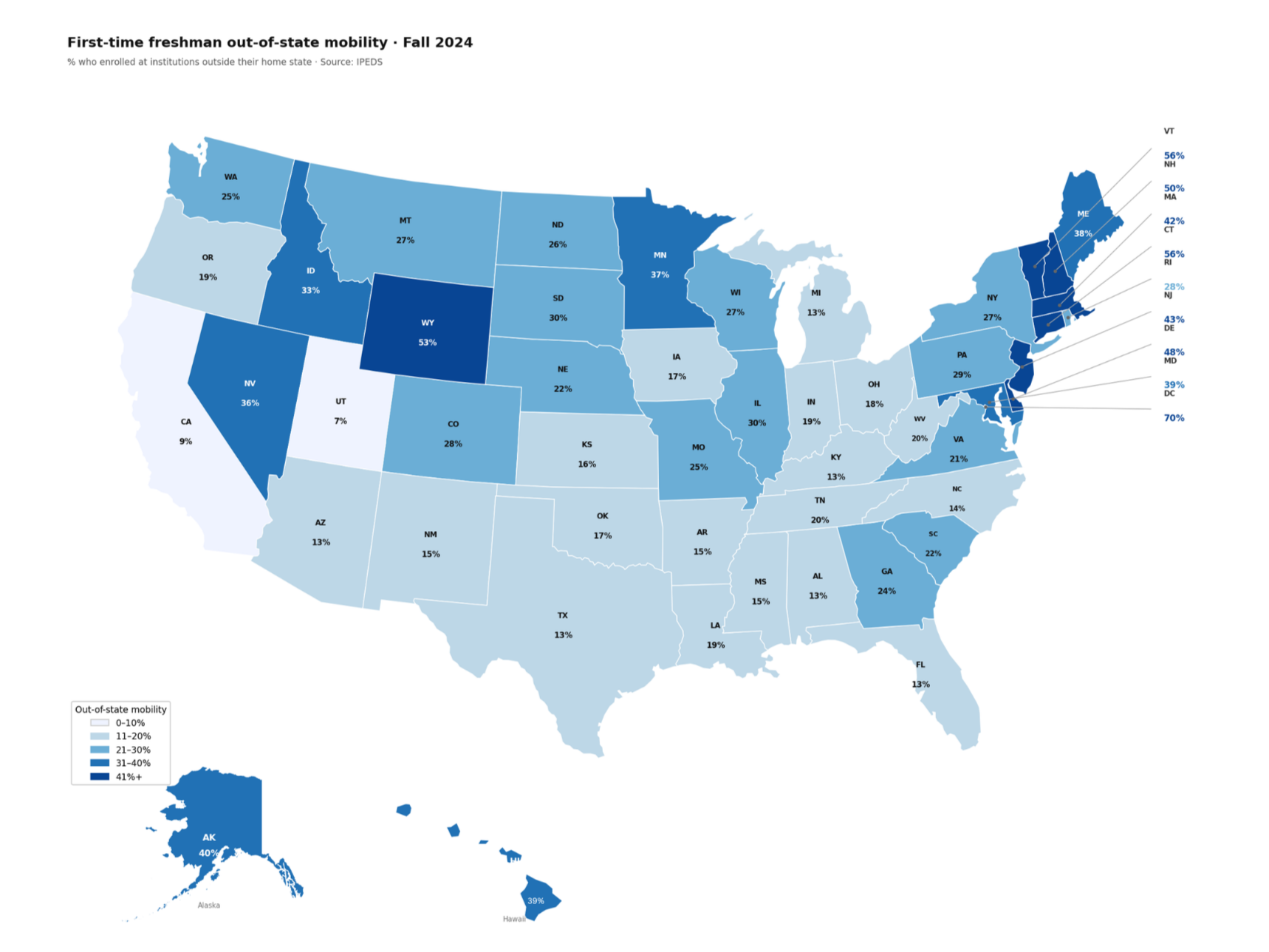
Did you know that well over 70% of US students stay in their home state for college or university? Some states, like California, it exceeds 90%. For many US students going to college in-state is often hours away from home, those who go out of state are making a substantial move, often many hours and one or more flights away, so it’s no wonder going overseas for a degree doesn’t factor into American minds as much as many other countries looking to study abroad.
For many US students, the thought of going abroad does seem exciting and doable, for a semester, maybe two, but for many earning their full degree overseas is just not a factor. And while there are thousands of students going to the UK each year for their degree, it still only represents a fraction of a percent of US college students.
I believe there is a larger pool of students who would thrive at UK universities but either the UK is an unknown option, or one that seems fun, exciting and romantic but may not make it past the application. So how do we go from unawareness or interest at the top of the funnel, to engagement, real consideration and enrollment?
To start, I think its awareness of two things: familiarity bias and what state colleges and universities are offering to students. While these are separate, they are intrinsically linked.
We are wired for familiarity
Our brains like what is familiar because it is perceived as safe and trustworthy. We tend to favor things that are familiar over the unfamiliar when it comes to making high-impact decisions, while novelty increases dopamine and interest, it may not last if decisions are bigger and more costly. This may be why you see students apply to UK universities to only change their mind, not for another UK institution, but for a university much closer to home. Novelty sparked initial engagement, but familiarity won out over time.
From a young age, students are exposed to colleges and universities in their communities. Universities show up in elementary schools through enrichment programs, summer camps, and outreach. They employ our family members, neighbors, and teachers. They provide services through health clinics and food banks. They bring people together at county fairs, festivals, and sporting events. And, proximity can extend past state borders, family members share stories of their alma mater, family trips spent in high-vibe college towns, all create that familiarity bridge. This is all before we start thinking through admissions requirements and the ROI of a degree.
The State College and University Offering
It would be foolish of me to surmise that decision making around universities is a result of familiarity bias and not genuine cognitive reasoning - in fact I think it involves both, and they both support each other. Familiarity bias creates a starting point for how students and families assess new universities they come across - it makes sense use what you know and what is familiar to make sense of what is unfamiliar. And when looking up-close, local state universities and colleges offer something that can be hard to compete with, access: affordability, admissions pathways and local industry links and connections.
Cost: In-state tuition at state universities is almost always more affordable than any out-of-state alternative. Community colleges can be dramatically more affordable, free in some places for qualifying students, which is why many students, smartly, complete their first year or two at a community college and then transfer, saving thousands of dollars. States also offer grants available only to residents, not transferable elsewhere. Some states, like Washington, have gone further by authorizing community colleges to offer bachelor’s degrees in high-demand fields.
Admissions pathways: Most state systems include institutions across a wide range of selectivity, meaning students at various academic levels can find an entry point, though many states have highly competitive options. Community colleges offer open access through transfer agreements (at times admissions guarantees), a pathway into many state university options, often including more selective institutions.
Industry connections: Students who plan to live and work near home often see staying in state as the safer route into a familiar job market. Local universities have established relationships with regional employers, alumni networks, and industries that out-of-state institutions simply cannot replicate.
Gaps and Frustrations
Unlike many countries, the United States does not operate under a centralized ministry of education. While the federal government plays a role through financial aid, civil rights enforcement, and accreditation oversight, states largely govern and fund (though state taxpayers) their public higher education systems. And this is where there can be dramatic differences in what is offered or available to students in one state versus another.
Many states, while offering great benefits to their students, have struggles that are causing frustration to many students and families. Costs are rising, budgets are being cut, universities and colleges are relying on out-of-state and international student tuition dollars which can make state universities more selective for their own in-state students. Increasingly unclear admissions criteria masked as holistic admissions can set students up for waves of university rejections and increased numbers of applications per student, straining local admissions offices. Community College systems may struggle with consistent successful transfer outcomes, and retention problems rising with valid concerns over degree ROI. And, the list goes on and is varied from state to state. But it is in these gaps and frustrations where the UK has a solid proposition to offer students, cost on par or less than out-of-state or private, and clear and transparent admissions criteria and processes, but how do we get students to see this as a viable option for them, when familiarity risks pulling them back into local options?
Leveraging Novelty and Becoming Familiar
It is an uphill battle, but not an impossible one. The key is how to use novelty, which UK universities have in spades, and embed the university offering in a familiar way so that the brain doesn’t see it as “too unfamiliar”.
The late Professor Steven Kahl of Dartmouth’s Tuck School of Business (article link below) says that successful innovations combine something new with something already known. If an idea is too familiar it risks being ignored. If an idea feels too unfamiliar, people struggle to categorize it and reject it.
Kahl argues that people use the existing categories they have to make sense of the new. That categorization determines how we evaluate it, what we compare it to, what we expect from it, and whether we trust it. The opportunity is for UK universities to pair their innate novelty and university offering with categories and values that American families already understand and trust, the same categories state university systems have built its reputation on and with which families are familiar.
What ways can you create or bridge familiarity with US students and families?
Next Month
Next month’s issue will look at the growing problems and frustrations within US admissions and how UK universities can leverage their admissions transparency and use novelty-familiarity balance.
Throughout this series I will look at the specific factors that impact how US students and families make decisions about university. For each one I will address how and where it shows up in the decision process and what UK universities can do, making specific use of the novelty-familiarity balance to move students from awareness to real consideration.
Additional Learning and Resources:
Podcast: The Brainy Business with Melina Palmer Embracing Familiarity Bias: The Comfort of the Known – The Brainy Business
Podcast: The Brainy Business with Melina Palmer Disney: A Behavioral Economics Analysis – The Brainy Business
Kahl, S.J. (2013). Making New Products Feel Familiar. Tuck School of Business at Dartmouth. tuck.dartmouth.edu/news/articles/making-the-unfamiliar-familiar
Community College Research Center, Columbia University. An Introduction to Community Colleges and Their Students. ccrc.tc.columbia.edu